
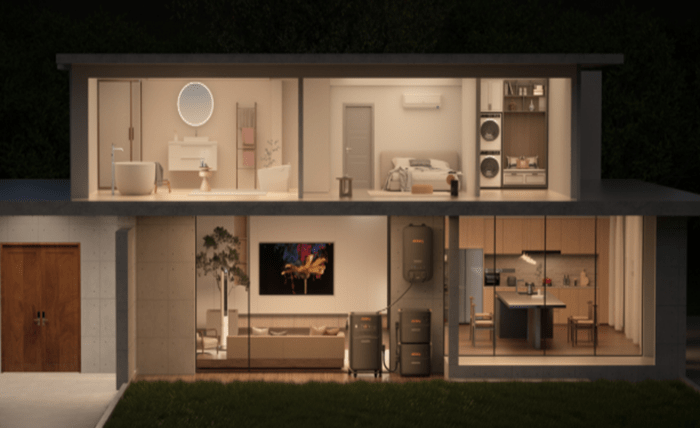
Have you ever wondered what else you can have in your backyard besides a lawn and a barbecue grill? Can it become a source of income, a studio, or even a cozy home?
Backyard homes, also called accessory dwelling units (ADUs), have grown in popularity across North America, especially in California and Los Angeles. For homeowners, they offer flexibility and an opportunity to increase property value while creating a practical living space on an existing lot.
Next, this article will introduce how to revitalize your backyard with new possibilities, from core concepts and practical value to construction steps, including portable battery power stations for backyard homes.
What is a Backyard Home?
A backyard home is a fully functional secondary residence that shares the same lot as a primary house. Unlike simple backyard shed homes or storage units, it is built to meet the same living standards as any other home, with its own kitchen, bathroom, and sleeping area.
Cities across North America often classify them as Accessory Dwelling Units, or ADUs. They are becoming an increasingly important part of urban housing strategies because they provide additional living space without needing any extra land outside your house.
For many property owners, a backyard home serves as a flexible solution to rising housing costs. Local governments also see them as a way to ease housing shortages without building large apartment blocks.
Main Types
Here are the different types of mobile home backyard ideas:
-
Detached
A detached backyard home is built as a stand-alone unit, separate from the primary house. It often takes the form of a small cottage, guest house, or modern mobile home in backyards.
Because it does not share walls with the main residence, it gives occupants greater privacy and independence, making it especially attractive for rental use or extended family members who want their own space.
Detached designs also give homeowners more freedom to explore different architectural styles. They can be customised to complement or contrast the main residence depending on preference.
-
Attached
An attached backyard home is directly connected to the main property. This type of home is often created by extending the side or rear of the house, or by transforming an existing garage into a livable area.
It allows homeowners to maximize the usability of their available land and wall without the need to construct a separate building. While it provides less privacy than a detached unit, it is often more affordable to build and can still offer many comforts. These designs also allow you to extend your home’s utility connections easily.
-
Conversion
Conversion means turning an existing space, such as a garage, basement, or even a small warehouse, into a legal dwelling that meets residential standards.
This option uses structures already on the property, helping reduce costs and shorten construction time compared with building a new unit. It also allows homeowners to adapt underused areas into comfortable living quarters while meeting safety and building regulations.
Is a Backyard Home Worth the Investment?
Here are some major advantages of investing in a backyard home:
-
Generate Substantial Rental Income
A backyard home can provide an additional source of income to homeowners. In cities where housing is in high demand, backyard homes can be rented out at competitive rates, giving owners a way to offset mortgage payments or fund other expenses.
Well-designed layouts with private entries and full amenities make these units attractive to professionals, students, or travellers looking for comfortable accommodation close to established neighbourhoods.
-
Significantly Increase Property Value
Adding a backyard home can substantially boost the value of residential property. Buyers often see an accessory unit as an asset that broadens how the land can be used, making the entire lot more appealing.
Properties with secondary dwellings typically stand out in competitive markets, and appraisals may reflect higher worth due to the extra living space and rental potential.
-
Accommodate Extended Family Living
A backyard home is also an effective way to support extended families living in the same home. It offers privacy and independence for elderly parents who can benefit from proximity to younger people while still needing their own space.
Graduated children starting careers or saving for a home can stay close to their parents without sacrificing autonomy. These arrangements create opportunities for families to share resources and provide support while still respecting individual lifestyles.
-
Flexibility and Functionality
Backyard homes offer exceptional versatility, which increases their appeal even further. They can serve as a quiet studio for creative work, a home office for remote professionals, or a retreat where hobbies can flourish without cluttering the main house.
They also provide comfortable quarters for visiting friends or relatives, letting hosts maintain household routines while offering their guests privacy.
How to Build Backyard Homes?
Now let’s have a look at how to build backyard homes:
-
Understand Local Regulations
The first step is to learn the rules that govern secondary housing units in your area. Local authorities may set limits on height, total construction area, or how far a structure must stay away from property boundaries.
Some jurisdictions also have owner-occupancy requirements and meet parking and fire-safety standards. Checking zoning codes and speaking with planning staff early helps you avoid costly redesigns and fines down the road.
-
Planning and Design
Good planning determines how well a backyard home will serve its purpose.
- Begin by defining the primary role of your construction, whether you want a rental unit, guest suite, or home office.
- Prepare a budget that covers site preparation, building materials, permits, and final finishes.
- Choose a construction method that suits your timeline and financial goals. Traditional construction provides greater flexibility in layout and style, while a prefabricated or mobile home in the backyard can reduce the time consumed and labour costs.
Make sure that the newly designed space is energy efficient and provides enough storage solutions for a comfortable living.
-
Choose a Contractor
Selecting the right contractor is one of the most important steps in building a backyard home. Look for professionals who have proven experience with accessory dwelling units and try to see their already completed projects.
Your contract needs to clearly explain the scope of work, materials, timelines, and inspection schedules so you understand what is included. A dependable contractor also helps you interpret local building requirements and keeps each stage of construction organized and on schedule.
-
Apply for Permits
Construction permits are required in almost every jurisdiction, and they cover zoning, safety, and utility connections. Submitting complete and accurate applications avoids long delays.
Many cities even offer streamlined approval processes for backyard homes because they support housing expansion.
Without the proper permits, a homeowner risks fines, forced removal of the unit, or difficulties selling the property in the future. Working with a contractor familiar with the local permitting office often makes the approval process faster and less stressful.
-
Construction and Planning for Water, Electricity, and Furniture Solutions
After all permits are approved, you can go ahead with construction. Start by preparing the site, followed by completing the foundation work, framing, and interior finishing.
Careful planning for utilities is essential at this stage. A backyard home needs safe and efficient connections for water, electricity, gas, and internet service. Some owners prefer linking these systems to the main house, while others install separate meters to simplify rental management.
Choosing space-saving furniture, well-planned layouts, and smart storage keeps smaller units comfortable and functional without feeling crowded.
How to Choose a Power Source for Your Backyard Home?
-
Integrate with the Main House’s Power Grid
The most common and efficient solution for powering a backyard home is to connect it directly to the main house’s electrical system. This approach keeps things simple, as the unit draws energy from the same source as the primary residence. In many cases, it is also the most affordable option because no separate infrastructure is needed.
However, homeowners should confirm that the existing electrical panel can handle the added demand. If not, an upgrade may be required to prevent overloads and ensure safety.
Integrating with the main grid also makes billing easier since all energy use appears on one utility statement.
-
Portable Generator Solutions
However, integrating with the main power grid does not work well when the backyard home is not in your use or you do not want to share bills for both your houses. Sometimes separating the electrical systems of backyard homes makes sense because exceeding certain consumption thresholds can increase base tariffs, which in turn raises overall energy bills.
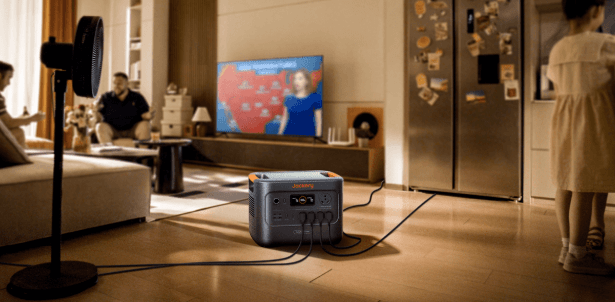
That is why other homeowners prefer portable home battery backup solutions for their backyard homes. For example, portable solar power generators give backyard homes reliable, quiet power without fuel fumes or complex wiring changes. Here are the two famous solar power generators in this regard:
-
Jackery Solar Generator HomePower 3000
Jackery Solar Generator HomePower 3000 suits most backyard homes that need dependable and quiet power without fuel or fumes. The solar generator carries a 3072Wh capacity and supports up to 3600W output with a 7200W surge, which covers common essentials such as a refrigerator, WiFi, fans, lighting, and device charging for roughly 2 days of typical use.
- High Efficiency and Economy: The Jackery Solar Generator HomePower 3000 features a battery life of up to ten years and offers a 5-year warranty, helping users save up to 25% on annual energy bills.
- Multiple Fast Charging Options: It supports various efficient charging modes, including AC charging (1800W, 2.2 hours), AC + DC hybrid fast charging (2500W, 1.7 hours), solar charging (400W, 11 hours), gas generator charging (2.2 hours), and car charging, ensuring rapid power replenish.
- Home Circuit Integration: Equipped with multiple ports to connect various essential devices, it can be easily integrated into home circuits by adding a manual transfer switch, enabling power supply to critical household circuits.
-
Jackery Solar Generator 5000 Plus
The Jackery Solar Generator 5000 Plus is an ideal choice for larger or more power-hungry backyard homes that may run several rooms or heavier loads. Its power station provides a base 5040Wh capacity and a high output of up to 7200 W with 14400 W surge, and it can expand to a multi-battery system in the 5 to 60 kWh range.
- Wide compatibility: Dual voltage support at 120 V and 240 V increases compatibility with demanding appliances and broader household scenarios.
- Emergency preparedness: For a more comprehensive coverage, the unit works with Jackery’s Smart Transfer Switch so you can feed home circuits and keep essentials like refrigeration, networking, lighting, or any other appliance powered during an outage.
- Multiple Fast Charging Options: It offers various efficient charging modes, including AC charging (1800W, 3.5 hours), solar charging (1000W, 6.5 hours), smart transfer switch charging (4000W, 1.7 hours), AC + solar panel+smart transfer switch hybrid fast charging (Max 4000W, 1.7 hours), and high-voltage PV charging (4000W, 1.7 hours), ensuring rapid power replenish.
- Eco-friendly and powerful: Zero emission operation allows indoor placement, and the abundance of output ports allows you to power a number of devices directly from the battery pack.
Wrapping-Up
Backyard homes allow property owners to expand living space, support family, or create a steady rental stream without purchasing new land. Success depends on sound planning, quality construction, and dependable access to electricity.
Portable solar generators make it easier to keep essential services running while avoiding fuel fumes or complex wiring. Jackery products such as the Jackery Solar Generator HomePower 3000 and the Jackery Solar Generator 5000 Plus supply clean, quiet energy enough for most backyard homes’ needs.
Visit the Jackery website now for your backyard homes!


